From Regulation to Workflow: Operationalising AI Compliance Under the EU AI Act
Turning legal obligations into engineering processes
The EU AI Act is often described in legal terms. For companies building or deploying AI systems, however, its real impact is operational.
For high-risk systems, compliance is not achieved through policy documents alone. It requires the integration of regulatory requirements into the design, development, and deployment lifecycle of AI systems.
The central challenge is therefore one of translation: from legal provisions to repeatable workflows.
The lifecycle approach to compliance
The Regulation implicitly adopts a lifecycle model. Obligations apply not only at the point of market entry, but throughout the operation of the system.
This is reflected in the requirement for continuous risk management:
High-risk AI systems must operate under a risk management system that is maintained “throughout the entire lifecycle” (Article 9)
This shifts compliance from a static certification exercise to an ongoing process embedded in technical operations.
Core pillars of operational compliance
Three provisions form the backbone of high-risk AI obligations:
1. Risk management (Article 9)
Article 9 requires a structured and continuous process to:
Identify risks to health, safety, and fundamental rights
Analyse and evaluate those risks
Implement mitigation measures
Monitor effectiveness over time
This is not limited to initial development. It must be updated as systems evolve.
2. Data governance and bias control (Article 10)
The Regulation imposes strict requirements on training, validation, and testing data:
Data must be relevant, representative, and free of errors
Bias must be identified and mitigated
Data governance processes must be documented
In practice, this introduces formal accountability into data science workflows.
3. Technical documentation (Annex IV)
Providers must produce detailed documentation enabling authorities to assess compliance.
This includes:
System architecture and design choices
Training methodologies
Performance metrics
Risk mitigation measures
The documentation must be sufficiently detailed to allow traceability and auditability.
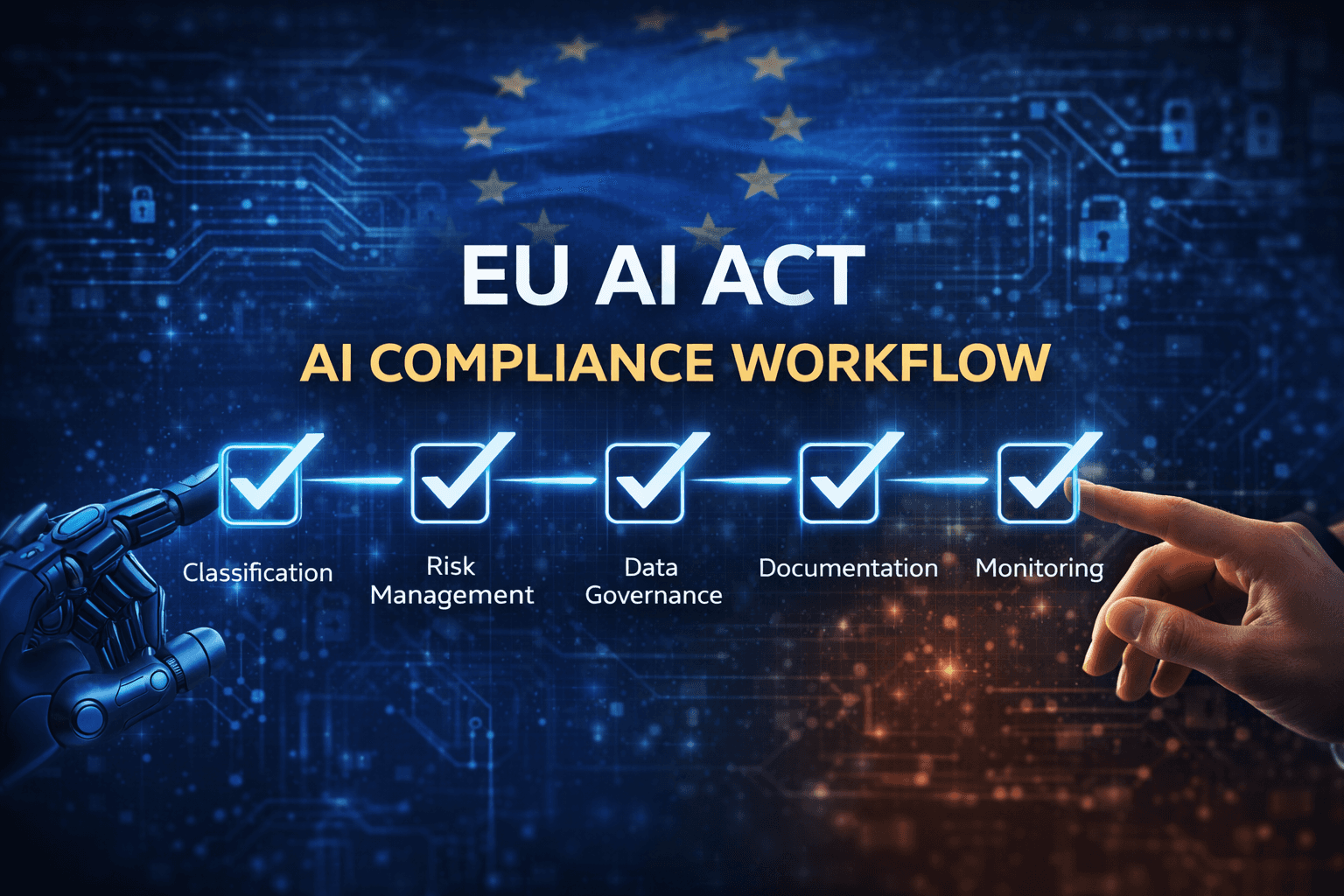
From legal text to a five-step workflow
To operationalise these requirements, companies typically converge on a structured workflow.
Step 1: System classification
Determine whether the AI system qualifies as high-risk
Map its intended purpose against Annex III
This step defines the regulatory scope.
Step 2: Risk mapping and controls
Identify potential harms (e.g. discrimination, exclusion)
Define measurable risk indicators
Implement mitigation strategies
This corresponds to Article 9 requirements.
Step 3: Data pipeline governance
Audit training and validation datasets
Implement bias detection and correction mechanisms
Document data provenance and processing steps
This operationalises Article 10.
Step 4: Documentation and traceability
Generate technical documentation aligned with Annex IV
Ensure version control and reproducibility
Maintain logs for system behaviour and updates
This step is often underestimated but central to compliance.
Step 5: Monitoring and post-deployment control
Continuously monitor system performance
Detect drift, bias re-emergence, or unintended effects
Update risk assessments accordingly
This closes the lifecycle loop required by the Regulation.
Organisational implications
Implementing this workflow requires coordination across functions:
Engineering: system design, logging, monitoring
Data science: dataset quality and bias mitigation
Legal and compliance: interpretation and oversight
Product teams: aligning system purpose with regulatory classification
In many organisations, these functions operate in silos. The AI Act effectively forces their integration.
The cost of retrofitting compliance
A common response is to treat compliance as an add-on. This approach is rarely effective.
Retrofitting documentation, risk controls, and monitoring mechanisms into an existing system is typically more costly and less reliable than designing them from the outset.
The Regulation’s lifecycle approach makes this particularly challenging: compliance must be designed in, not appended later.
Strategic implications for SaaS providers
For SaaS companies, the operationalisation of compliance creates both constraints and opportunities:
Standardised workflows can be turned into product features
Compliance capabilities can become a differentiator in enterprise sales
Early alignment reduces long-term regulatory friction
Conversely, failure to operationalise compliance may limit market access, particularly in regulated sectors such as finance.
Conclusion
The EU AI Act does not merely impose legal obligations. It requires a reconfiguration of how AI systems are built and maintained.
The firms that adapt most effectively will be those that treat compliance not as a legal burden, but as an engineering discipline — one that can be systematised, measured, and scaled.